
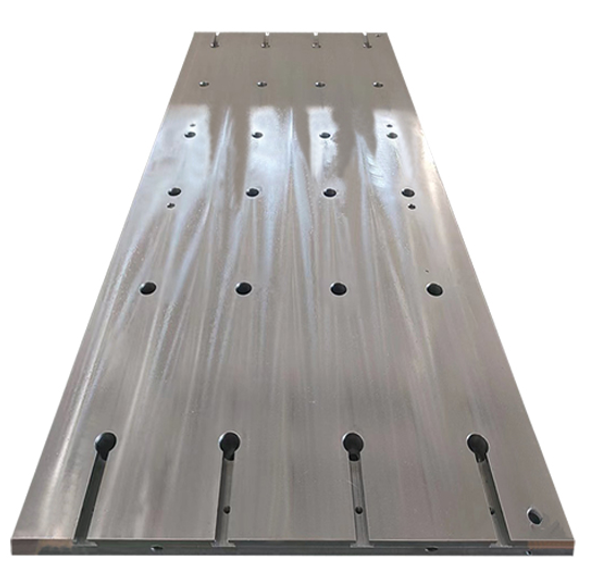
In new energy equipment, water-cooled and heating plates serve a clear function: either to evenly dissipate heat from the source or deliver it uniformly to the working surface. Though seemingly simple structural components, post-delivery issues typically stem from two root causes: improper channel design leading to uneven temperature control, and inadequate sealing surface machining causing leaks. If these problems are only identified at the customer site, rework costs far exceed the expense of adding a few extra steps during manufacturing.
Channel Layout: Pressure Drop and Distribution Are Hard Constraints
Designing flow channels for large cold plates involves a core trade-off: longer paths increase pressure drop, while more parallel channels make flow distribution harder to balance. The header design (manifold) determines flow uniformity—a small cross-sectional area can cause over 20% flow difference between inlet and outlet channels, whereas an oversized one encroaches on the effective heat transfer area.
When reviewing drawings, procurement and process engineers should focus on two key metrics: ensure the pressure drop across each channel's inlet and outlet stays within design limits (typically a deviation of no more than 5%), and verify that the number of bends and total path length align with the system's actual supply capacity. Excessively small corner radii can accelerate localized erosion-corrosion, significantly increasing leakage risk over extended operation periods.
Deep Hole Machining: Straightness and Chip Evacuation Determine Channel Quality
Large water-cooled plates typically use deep-hole drilling machines. Due to tight hole spacing and high length-to-diameter ratios, precise tool guidance and effective coolant flushing are critical. The most important control parameter is hole straightness. If deviation exceeds allowable tolerances (typically in the range of 0.1 mm/500 mm for large panels), wall thickness between adjacent channels may locally thin out, reducing pressure-bearing capacity.
Poor chip evacuation is another common issue: chips clogging the hole can score the bore wall, creating micro-cracks that act as fatigue sources during subsequent thermal cycling. A 4-axis machining center paired with high-pressure internal coolant tools effectively improves chip evacuation conditions. This is why we prioritize this solution for long thin-hole feature machining.
Sealing surface: Flatness and roughness are both essential.
The sealing interface between the flow channel cover and the body is the most prone to quality issues. For large-sized plates, flatness is constrained by two factors: residual stress in the material and clamping deformation during machining. The former is controlled through aging treatment or stress-relief annealing; the latter requires optimizing the clamping scheme during precision machining to distribute clamping force evenly across the entire area rather than concentrating it at four points or corners.
Surface roughness directly impacts static sealing: if Ra is too high, the gasket cannot fill microscopic peaks and valleys under pressure, increasing leakage risk; if Ra is too low, insufficient micro-interlocking occurs between the gasket and metal surface, leading to seal failure due to relative sliding under vibration. Precision grinding combined with optimized cutting parameters ensures roughness remains within the target range.
End-to-end validation: Catch issues before they leave the factory.
Before shipping, water-cooled plates must undergo at least three inspections: leak or hydrostatic testing (to verify pressure integrity of flow channels and sealing surfaces), full-plane flatness inspection (using CMM or bridge gauges for point-by-point measurement), and visual or borescope checks for channel blockage. Incoming material inspection records batch-level mechanical properties and surface defects. In-process巡检 covers key dimension deviations across rough, semi-finish, and finish machining stages. Final inspection ensures complete coverage of all test items.
The mandatory process review for every order is a pre-order gate at Jinshanhu. During the drawing review phase, the purchaser intervenes to verify each control point with the manufacturer—ensuring manifold layout is manufacturable, sealing surface tolerances are achievable, and inspection standards meet end-use requirements. This significantly reduces post-production communication and rework costs. Clearly articulating engineering logic and embedding control points into the drawings represents the most direct path from design to delivery for large water-cooled plates.
All four control points must ultimately be reflected in a manufacturing-ready drawing. If you have requirements for large-scale water-cooled or heated plates, submit your drawings to Wuxi Jinshanhu Nonwoven Equipment Co., Ltd. for a process feasibility review before proceeding. This review will not provide a quote; instead, it will deliver an actionable feasibility conclusion covering: whether the plate can be reliably manufactured, how the four control points map to specific processes and inspection methods, and where cost differences lie between pilot runs and mass production.